
 OPEN ACCESS
 PEER-REVIEWED |
RESEARCH ARTICLE
Species Composition and Temporal Patterns of Upstream-Migrating Fish at Kamijoro Weir, Yogyakarta, Indonesia
Article Sidebar
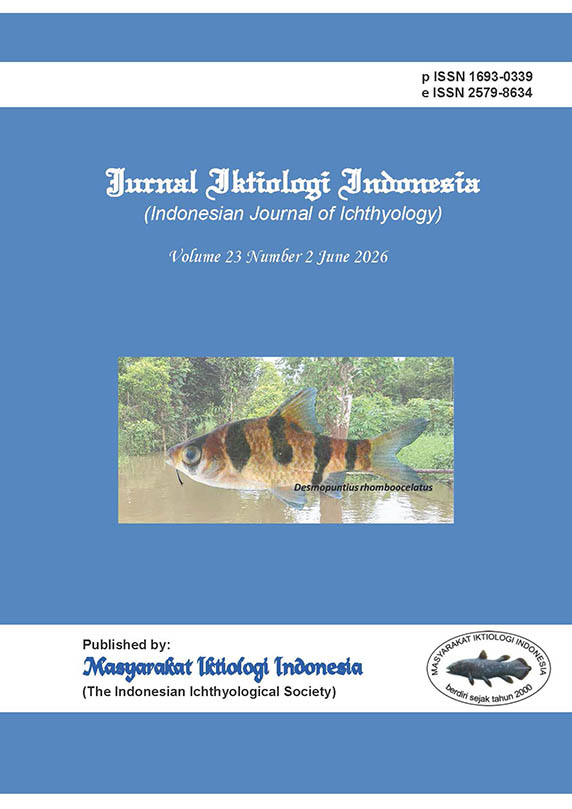
How to Cite
 The article can trace at:


Main Article Content

Abstract
This study aimed to identify species composition, analyze temporal migration patterns, and assess gonad maturity stages of upstream-migrating fish at the Kamijoro Dam on the Lower Progo River, Yogyakarta. We conducted the research over five months (September 2025–January 2026) using a hanging fish trap net installed at the dam, with morning and afternoon sampling. We identified each specimen, measured its total length and weight, and assigned a gonad maturity stage (GML I–V) based on descriptive criteria. We captured 1,603 individuals from seven species of the family Cyprinidae, dominated by Barbonymus schwanefeldii (42.98%) and Mystacoleucus obtusirostris (41.92%). Catch numbers peaked in October (1,028 individuals; 64.1%) and subsequently declined sharply by January (11 individuals). Most catch (81.2%) occurred in the afternoon. GML analysis revealed the following distribution: GML I (3.2%), II (48.9%), III (22.3%), IV (23.4%), and V (2.1%). The dominance of immature fish (GML II–III = 71.2%) suggests that the migration was primarily driven by foraging, whereas the presence of sexually mature fish (GML IV = 23.4%)—specifically among Osteochilus vittatus (56.5%) and Labiobarbus leptocheilus (58.3%)—indicates the occurrence of reproductive migration. The afternoon catch bias reflects circadian rhythms, while the exclusive presence of Cyprinidae suggests community simplification resulting from the weir's influence. The study concludes that the Kamijoro Weir serves as a critical aggregation point for migratory fish exhibiting distinct temporal patterns, highlighting the need for sustainable fisheries management and long-term monitoring.
Downloads article
Article Details
License |
|
|

References
Arthington, A. H., Dulvy, N. K., Gladstone, W., & Winfield, I. J. 2016. Fish conservation in freshwater and marine realms: status, threats and management. Aquatic Conservation: Marine and Freshwater Ecosys tems, 26(5), 838-857.
Atminarso, D., Baumgartner, L. J., Watts, R. J., Rourke, M. L., Bond, J., & Wibowo, A. 2023. Evidence of fish community fragmentation in a tropical river upstream and down-stream of a dam, Pacific Conser-vation Biology, 30(1).
Chen, Q., Li, Q., Lin, Y., Zhang, J., Xia, J., Ni, J., and Tang, L. 2023. River damming impacts on fish habitat and associated conservation measu-res. Reviews of Geophysics, 61(4),
Cowx, I. G., Vu, A. V., Hogan, Z., Mallen-Cooper, M., Baumgartner, L. J., Lai, T. Q., and Sayer, C. A. 2025. Understanding the threats to fish migration: applying the global swim-ways concept to the lower Me-kong. Reviews in Fisheries Science & Aquaculture, 33(2), 257-285.
Hood, G. R., Blankinship, D., Doellman, M. M., & Feder, J. L. 2021. Temporal resource partitioning mitigates inter-specific competition and promotes coexistence among insect parasi-tes. Biological Reviews, 96(5), 1969
Kärgenberg, E., Økland, F., Thalfeldt, M., Thorstad, E. B., Sandlund, O. T., & Tambets, M. 2020. Migration patterns of a potamodromous piscivore, in a river–lake system. Journal of fish biology, 97(4), 996-1008.
Kemp, P. S. 2015. Impoundments, barriers and abstractions: impact on fishes and fisheries, mitigation and future direc-tions. Freshwater fisheries ecology.
Leu, M. Y., Meng, P. J., Siong Tew, K., Kuo, J., & Hung, C. C. 2012. Spawning and development of larvae and juveniles of the Indian Ocean oriental sweetlips, Plectorhinchus vittatus (Linnaeus, 1758), in the aquarium. Journal of the world aquaculture society, 43(5), 595-606.
Nuon, V. 2025. Patterns and determinants of Mekong and Tonle Sap fish diver-sity: functional responses of fish communities under global changes
Pamungkas, W., Arifin, O. Z., Subagja, J., Imron, Anggraeni, F., Astuti, D. N., & Marnis, H. 2022. Reproductive Performance of Osteochillus vittatus Outside of the Natural Environment. In IOP Conference Series: Earth and Environmental Science, Vol. 1118, No. 1, p. 012018. IOP Publishing.
Pavlov, D. S., Kostin, V. V., & Mikheev, V. N. 2021. Migrations of young fish in anthropogenically transformed rivers: responses of cyprinids and percids to ecological filters and barriers. Water, 13(9), 1291.
Reis, A. D. S., Albrecht, M. P., & Bunn, S. E. 2020. Food web pathways for fish communities in small tropical streams. Freshwater Biology, 65(5), 893-907.
Tessier, A., Beaune, D., Guillard, J., Kue, K., Cottet, M., Chanudet, V., ... & Panfili, J. 2019. Life history traits and exploitation of Hampala barb (Hampala macrolepidota-Cyprinidae) in a subtropical reservoir (Lao PDR). Cybium, 43(4), 351-365.
Wang, G., Mang, S., Cai, H., Liu, S., Zhang, Z., Wang, L., & Innes, J. L. 2016. Integrated watershed management: evolution, development and emerging trends. Journal of Forestry Research, 27(5), 967-994.
Williams, J. G., Armstrong, G., Katopodis, C., Larinier, M., & Travade, F. 2012. Thinking like a fish: a key ingredient for development of effective fish passage facilities at river obstructions. River Research and Applications, 28(4), 407-417.